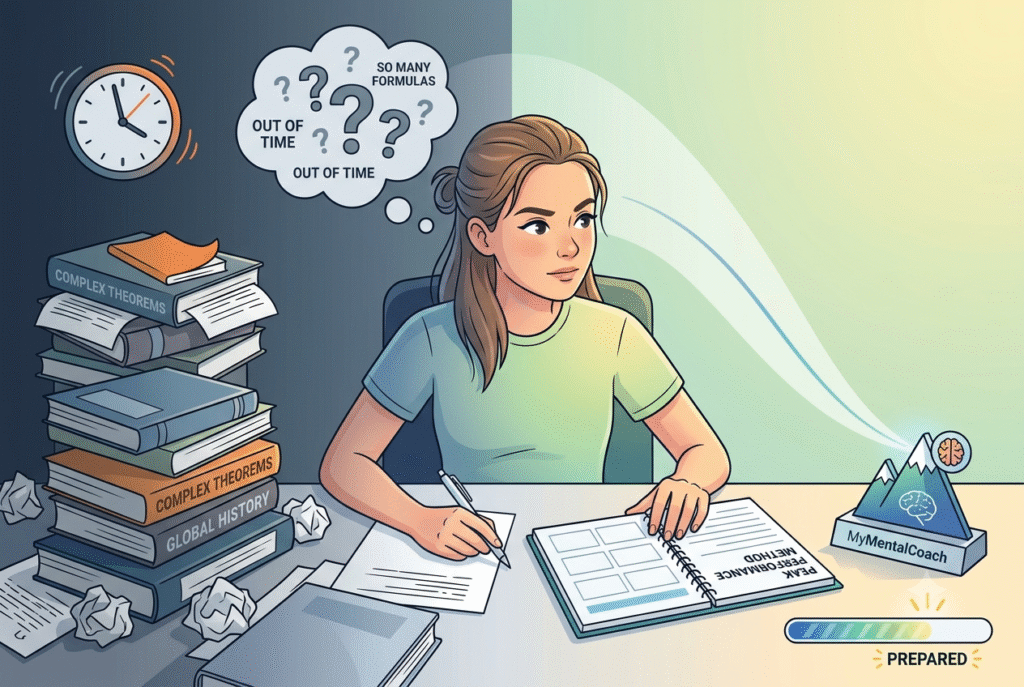
Your entrance exam is approaching, and despite months of studying, you still feel you haven’t done enough.
You revise a chapter you thought you knew, struggle with a mock test, or hear a friend talk about their preparation, and suddenly, everything you have studied seems inadequate. But how do you know whether you are genuinely underprepared or simply struggling to trust your preparation?
Feeling unprepared can make you overlook what you know and lose valuable time worrying about what remains. Dr Swaroop Savanur, sports psychologist and Mental Conditioning and Peak Performance Coach, applies principles of mental training to help people understand how they respond to pressure and perform when it matters.
At MyMentalCoach, we believe that preparing your mind is an important part of preparing for performance. Discover three practical ways to assess your preparation more clearly, focus on what needs attention and approach your entrance exam with greater confidence.
You Have Been Studying, So Why Do You Still Feel Unprepared?
Your entrance exam is getting closer, but you still feel you have a lot left to do. You have attended classes, completed chapters, solved questions and spent hours at your study table, yet you are not sure whether your preparation is enough.
When you attempt a mock test and get a lower score than expected, you begin questioning what you have studied. When you hear other students discussing completed revisions or difficult questions they have already practised, you wonder whether you are falling behind.
Even topics you once understood may suddenly seem unfamiliar when you try to recall them. Before you know it, you are spending more time worrying about how prepared you are than understanding what needs your attention.
If you feel unprepared for your entrance exam, it is important to recognise that feeling unprepared and being unprepared are not always the same thing. Sometimes, there are genuine gaps in your preparation that need to be addressed.
At other times, the pressure of the approaching exam makes it difficult to recognise what you already know and how much progress you have made. Ignoring actual gaps will not help, but neither will assuming that your entire preparation is inadequate simply because you feel uncertain.
What matters now is understanding where you stand, identifying what needs attention and making the best use of the time you have left. You do not need to feel completely ready before you can take a useful step forward. Here are three ways to approach your preparation more clearly when you feel unprepared for the exam.

3 Ways to Stop Feeling Unprepared for Your Exam
1. Find Out Whether You Are Actually Unprepared or Just Feel Unprepared
When your entrance exam is approaching and you feel unprepared, your first instinct may be to look at everything you have not finished and assume you need to start working harder. But before you change your study plan or spend another hour revising a chapter, take a moment to understand where you actually stand.
There is a difference between a topic you have not studied, a topic you have studied but struggle to recall, and a topic you understand but no longer feel confident about because you are worried about your performance. Each situation needs a different response.
For example, if you revised a Biology chapter for NEET last week but cannot immediately recall a particular concept, it does not necessarily mean you have forgotten the entire chapter. Try answering a few questions without looking at your notes and then check your answers honestly.
You may discover that you remember most of the material but need to revisit a few areas. Give yourself 20 minutes to assess one topic, attempt relevant questions and identify what needs attention.
Ask yourself, “What do I already know? What needs more practice? What do I still need to understand?” This gives you a clearer picture of your preparation than repeatedly reading the same pages because you feel uncertain.
The goal is not to convince yourself that you are prepared when you are not. It is to understand your actual preparation instead of allowing the feeling of being unprepared to decide everything for you. Once you know where you stand, you can direct your time and effort towards the areas that genuinely need improvement, rather than treating your entire preparation as a problem.
2. Stop Looking at Everything Left to Study and Decide What to Do Next
When you look at the entire JEE or NEET syllabus and count the chapters you still have to complete, it can feel as though there is simply too much to do and too little time left. You sit down to study, remember another topic that needs revision, wonder whether you should switch subjects and eventually find yourself making yet another timetable instead of getting started.
The more you think about everything that remains unfinished, the harder it becomes to decide what deserves your attention first. If you are wondering what to do when you feel unprepared for an exam, start by bringing your attention back to the work in front of you rather than trying to solve your entire preparation at once.
Take a sheet of paper and divide your remaining topics into three groups: topics you have studied but need to revise, topics you understand but need more practice with, and topics you have not understood properly yet.
This simple exercise helps you see your preparation more clearly and decide where your time is most needed. Consider your exam date, the importance of each topic and the time available before choosing what to work on next.
If you have two hours for Physics, for instance, set a clear goal to revise a particular concept, practise questions related to it and review the mistakes you make. You may not complete everything on your list that day, but you will know exactly what you have worked on and what still needs attention.
Feeling unprepared can make you want to do everything at once, but effective preparation begins with knowing what to do next. You cannot change how much time has already passed, but you can make a more deliberate use of the time that remains.
This is especially important during last minute exam preparation, when constantly changing your plan can leave you feeling busy without helping you make meaningful progress. Instead of measuring your day by how much of the syllabus is still left, pay attention to the specific tasks you complete and the areas in which you improve.
3. Stop Waiting to Feel Confident Before You Start
When you feel unprepared for an entrance exam, it is easy to believe that you need to feel more confident before you can make progress. You might tell yourself that you will attempt a full mock test once you have revised a few more chapters, or that you will stop worrying once you have completed the syllabus.
But the more you wait to feel ready, the less opportunity you give yourself to practise, recognise your mistakes and understand what you can already do. Confidence does not always arrive before you begin.
Often, it develops as you see yourself handle questions, learn from errors and make progress in your preparation. This is something athletes experience too. Before an important competition, an athlete may still have doubts about their performance, but they learn to direct their attention towards what they can control rather than waiting for every doubt to disappear.
You can approach your exam preparation in the same way. Instead of repeatedly asking yourself, “Am I ready for the exam?”, ask, “What can I work on right now?” Attempt the mock test, even if you feel uncertain, and use your results to understand where you need more practice. When you make a mistake, focus on what it tells you rather than treating it as proof that you are not capable.
At the end of a study session, take a moment to identify what you completed and what still needs attention. These small, honest assessments help you build confidence from your actual efforts rather than from temporary feelings.
Learning how to build confidence before an exam does not mean convincing yourself that you will answer every question correctly. It means trusting your ability to prepare, respond to challenges and keep working when things do not go as expected.
You may not be able to control every question that appears in your entrance exam, but you can practise how you respond to uncertainty, mistakes and pressure.
When exam preparation stress makes you question everything you have done, bring your attention back to the next task you can complete. You do not have to feel completely prepared to begin, and you do not have to eliminate every doubt to give yourself a fair opportunity to perform under pressure.
What If You Still Feel Unprepared the Day Before the Exam?
If your entrance exam is tomorrow and you still feel unprepared, you may be tempted to stay up late, rush through unfinished chapters and keep testing yourself to see whether you know enough.
You might feel that every minute spent resting is a minute wasted, especially when you can think of topics you have not revised. But trying to cover everything at the last moment can leave you exhausted and make it harder to focus on what you already know. Instead, look at the time you have left and decide how to use it sensibly.
Review important concepts you have already studied, revisit mistakes that you understand how to correct and focus on material that deserves your attention based on your preparation. Avoid trying to relearn the entire syllabus overnight.
If you are feeling unprepared for an exam, the goal now is not to achieve perfect preparation in a few hours. It is to make the best possible use of the preparation you have already completed while addressing the most important gaps you reasonably can.
Give yourself time to prepare for the practical side of exam day, too. Check your admit card, required identification, reporting time and travel arrangements so that you are not dealing with avoidable uncertainty the next morning.
Make sure you get adequate sleep rather than sacrificing the night in the hope that a few extra hours of studying will make you feel completely ready. You may still have questions you cannot answer or topics you wish you had revised, and that uncertainty may not disappear entirely.
Acknowledge what remains unfinished without allowing it to occupy all your attention. When you feel unprepared the day before JEE, NEET or another competitive exam, remember that worrying about everything you do not know will not help you make better use of what you do know.
You cannot change your entire preparation overnight, but you can choose how you use your remaining time and how you approach the paper tomorrow. Focus on arriving prepared to give your best effort, one question at a time.
If you often question whether your preparation is enough, read our blog on how to stop doubting your exam preparation to understand how self-doubt can affect the way you view your progress.
You Do Not Have to Feel Ready to Take the Next Step
As your entrance exam approaches, you may still find yourself wondering whether you have studied enough, revised enough or practised enough to perform well. You may not feel as confident as you hoped to feel by now, and there may still be topics you wish you had more time for.
But rather than treating this uncertainty as proof that your preparation has not been good enough, take a closer look at where you stand. Identify what you know, be honest about what needs more work and decide how to use the time you have left.
When you feel unprepared for an exam, it is easy to become so focused on everything that remains unfinished that you overlook the progress you have already made.
Remember that effective preparation is not only about completing chapters. It is also about practising what you have learnt, understanding your mistakes and learning to respond when a question feels difficult.
You may not be able to control every question in your JEE, NEET or other entrance exam, but you can control how you prepare, how you use feedback and where you direct your attention next.
Feeling unprepared is a reason to assess your preparation, not a reason to dismiss all the work you have put in. You do not need to eliminate every doubt or feel completely ready before you begin the next task.
Take an honest look at your preparation, choose what needs your attention and keep moving forward. Confidence can grow as you build evidence of what you can do, one study session and one question at a time.
How MyMentalCoach Can Help Students Prepare Mentally for Exams
Feeling unprepared for an entrance exam does not always mean you have not studied enough. Sometimes, the challenge lies in managing the pressure, staying focused when doubts arise and trusting what you have learnt.
Just as athletes prepare their minds to handle competition, students can develop mental skills to approach exams with greater confidence and consistency. The aim is not to eliminate every worry or guarantee a particular result, but to learn how to respond to uncertainty, use feedback constructively and focus on what is within your control.
When you feel unprepared, take a step back, assess your preparation honestly and decide what needs your attention next.
At MyMentalCoach, mental training is built around the skills that help people perform at their best under pressure. Founded by Dr Swaroop Savanur, a Mental Conditioning and Peak Performance Coach with expertise in sports and performance psychology, we apply principles used to prepare athletes for competition to the challenges students face during entrance exam preparation.
Through structured mental training, students can work on focus, self-belief, consistency and responding more effectively to pressure.
If you would like to understand how mental training could support your exam preparation, Book a Free 15-minute Call with Dr. Swaroop Savanur by dialing +91 98237 91323.