
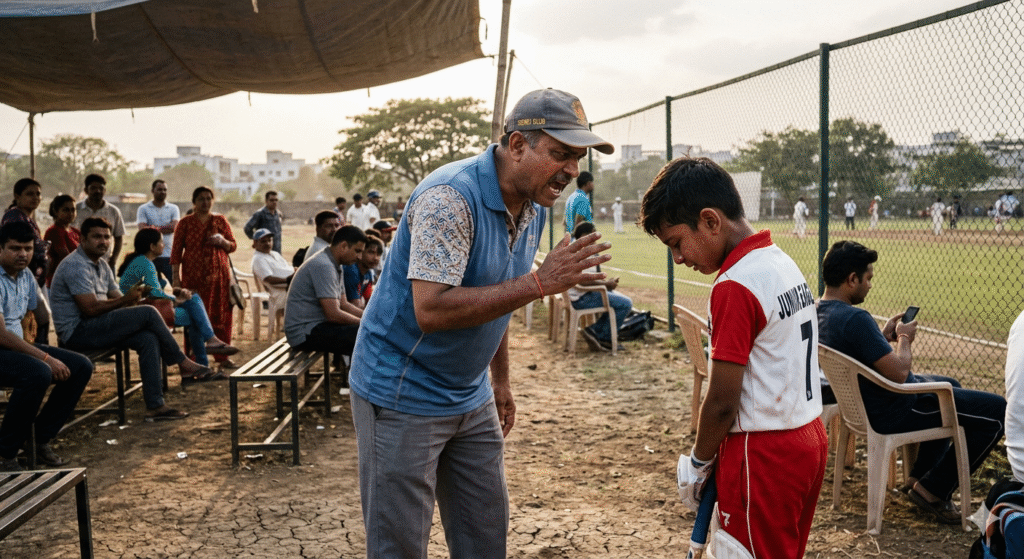
When a child loses badly—especially in a match they could have performed better in—shouting often feels like the most natural response for parents. In that moment, it feels immediate, justified, and even necessary.
But before reacting, it’s important to pause and ask:
“Is shouting simply a reaction driven by emotion?:
Or
“Should parents shout at their child after losing a match?”
The truth is, it’s a reaction.
Winning and losing are a natural part of sport. Even losing badly is part of the journey. But as a parent, when your child loses, your mind doesn’t just see the result—you think about everything behind it: the early morning practices, the time invested, the money spent, the adjustments around studies, and the effort from both you and your child.
And in that moment, it feels like something needs to be said. Or done.
But here’s the real question—will shouting, or even hitting (which is still common in many households), bring any of that back?
Your child already knows they didn’t perform well. They are already processing the loss internally. Shouting doesn’t improve performance—it often does the opposite.
In fact, research in sports psychology and child development consistently shows that harsh reactions like shouting or physical punishment increase anxiety, reduce confidence, and can negatively impact long-term athletic development and motivation. Instead of helping the athlete grow, it creates fear around failure.
At MyMentalCoach, we often see this pattern—where the intention is to push the child to do better, but the reaction unintentionally holds them back.
This is why it becomes important to shift from reacting emotionally… to responding consciously.
Is Shouting Really Helping or Hurting Teen Athletes?
Shouting, in the moment, can feel like it’s pushing your child to “wake up,” take responsibility, or perform better next time.
But for most teen athletes, it doesn’t land that way. Instead of hearing guidance, they experience it as pressure and judgment—especially right after a loss, when they are already emotionally and mentally vulnerable.
The brain at that point is not in a learning state; it’s in a protective state. When a parent shouts, the athlete’s focus shifts from “What can I learn from this?” to “How do I avoid feeling this again?” Over time, this creates a subtle but powerful change—they begin to play not to improve, but to avoid mistakes, avoid criticism, and avoid disappointing you.
That shift is where confidence slowly starts to drop.
There is strong scientific backing for this.
Research in sports psychology and adolescent development shows that high levels of parental criticism and negative emotional reactions are directly linked to increased performance anxiety, fear of failure, and burnout in young athletes.
Studies also highlight that environments perceived as controlling or harsh reduce intrinsic motivation—the internal drive that actually sustains long-term performance. In simple terms, shouting might create short-term compliance, but it weakens long-term growth.
At MyMentalCoach, we see this often—athletes who are technically capable but mentally blocked, not because they lack skill, but because they associate mistakes with negative reactions.
What they need in that moment is not more intensity from the outside, but better processing on the inside—and that starts with how the parent responds.
Read this blog titled “Eight Tips for Communicating with Adolescent Athletes Immediately after the Game: Win or Loss” to learn about more effective communication techniques to implement after a match.
3 Common Mistakes Parents Must Avoid After a Match
1. Turning the ride home into a post-mortem analysis
One of the most common patterns is what happens immediately after the match—especially in the car.
The athlete is still processing the game, replaying moments in their head, often already aware of where they went wrong. But this is when parents begin point-by-point analysis: “Why did you miss that?”, “What was that decision?”, “You should have…” What feels like guidance to the parent feels like overload to the child.
In that moment, the brain is emotionally charged, not receptive. Instead of learning, the athlete starts associating competition with interrogation.
Over time, this builds resistance—they either shut down, give one-word answers, or stop sharing altogether. The mistake here is not feedback—it’s timing.
2. Making the loss about sacrifice instead of the child’s experience
Statements like “Do you know how much we’re doing for you?” or “All those early mornings for this?” often come from a place of genuine investment.
But to a young athlete, this shifts the focus from their performance to your sacrifice.
It adds a layer of guilt on top of an already disappointing experience.
Instead of reflecting on the game, they begin to feel like they’ve let you down personally.
This is where sport slowly stops being their journey and starts feeling like a responsibility they must fulfill.
The pressure becomes external, not internal—and that’s where motivation starts to become fragile and dependent on approval rather than growth.
3. Expecting immediate explanations or accountability
Right after a tough loss, parents often want answers: “What happened?”, “Why didn’t you play your natural game?”, “What were you thinking?” But the reality is, most athletes themselves don’t fully understand it in that moment.
Performance breakdowns are rarely logical when emotions are high. Expecting clarity immediately can frustrate both sides—the parent feels the child is being careless or unaware, and the child feels misunderstood or cornered.
Reflection takes time. When pushed too early, athletes may either give defensive answers or simply say what they think the parent wants to hear.
The mistake is assuming that awareness should be instant, when in reality, it develops with the right space and guidance.
Watch this video by Dr Swaroop Savanur, India’s most experienced Sports Psychologist, titled, “The most DANGEROUS place after a Match I MyMentalCoach by Dr Swaroop” to learn about the worst thing you can do for your athlete after a match.

3 Simple Things Parents Should Do After a Match
1. First calm yourself, then talk to your child
After a bad match, parents are also emotional—sometimes even more than the child.
But if you speak in that state, it usually comes out as anger, taunts, or frustration. Instead, take a few minutes. Drink water, stay quiet, let the match settle. Then talk. Even saying something simple like, “It’s okay, not your day today” helps more than a long lecture. Your calmness decides how your child handles the loss.
If you are angry, they become tense. If you are steady, they start settling down.
2. Talk like a supporter, not like a coach
Many parents start giving technical advice immediately—what shot to play, what mistake happened, what should have been done.
But your role in that moment is not the coach. Your child already has a coach. What they need from you is support. Ask simple things like, “How are you feeling?” or just listen if they want to speak.
Even if you understand the mistake, that moment is not for correction. When parents try to become coach + critic together, the child starts feeling pressure from both sides.
3. Keep the focus on the next step, not the past match
After a loss, it’s easy to keep going back to what went wrong: “That one point changed everything,” “You always do this,” etc. But this keeps the child stuck in the same match mentally.
Instead, slowly shift the conversation forward: “What’s the next practice?”, “What do you want to work on now?” This helps the child move on faster and think ahead.
In sports, improvement comes from what you do next—not from repeating what already went wrong.
How MyMentalCoach Supports Parents and Young Athletes
At MyMentalCoach, we understand that sports parenting is not easy.
There are emotions, expectations, sacrifices—and in many moments, parents are simply trying to do what they feel is best for their child. But without the right guidance, even the right intention can lead to the wrong impact.
That’s exactly why we’ve created Sports Parents Corner—a free WhatsApp community for sports parents.
Inside this community, you will get:
- Practical tips you can apply immediately
- Blogs, ebooks, and short videos on real sports parenting situations
- Guidance on how to handle pressure, losses, and performance phases
More importantly, this is a non-judgmental space.
You can openly discuss your challenges, ask questions, and learn not just from our experts, but also from other sports parents going through similar journeys.
Click the link to join the community: Sports Parents Corner WhatsApp Community
If you’re looking for more personalized support, you can also avail a free 15-minute call with our team to understand how to better support your child’s mental and performance journey.
📞 Call/WhatsApp: +91 98237 91323
Because the right support to a young athlete doesn’t start on the field—
it starts at home.