In shooting sports, the difference between a perfect 10 and a narrow miss often comes down to focus, mental clarity, and emotional control.
While shooters spend years refining their technique and physical stability, many still struggle to perform the same way in competition as they do in practice.
The reason? The mental game of shooting is rarely trained with the same depth and structure as physical and technical skills.
From managing pressure in high-stakes matches to staying calm after a bad shot, the mind plays a decisive role in shooting performance, accuracy, and consistency.
Elite shooters understand that precision is not just about aiming at the target — it’s about controlling thoughts, breathing, and attention under pressure.
This is where shooting mindset training and structured mental training for shooters become essential. Skills like focus techniques, emotional regulation, visualization, and pre-shot routines help athletes stay composed, confident, and mentally sharp when it matters most.
At MyMentalCoach (MMC), we work with athletes to strengthen the mental side of performance through science-backed mental training programs designed specifically for precision sports like shooting.
Because in a sport where the margin of error is minimal, mental strength can be the ultimate competitive advantage.
Whether you’re a beginner, competitive shooter, coach, or sports parent, understanding the mental game can help you unlock greater control, confidence, and consistency on the range.
Why Shooting Is a High-Precision Sport That Demands Mental Alignment
Shooting is one of the few sports where millimeters decide the outcome. A tiny change in finger pressure, breathing, posture, or timing can shift the shot off target.
Unlike fast, reactive sports, shooting is slow, controlled, and precise. The athlete isn’t just competing against others — they’re competing against their own body and mind to stay perfectly steady.
Even when the technical skill is strong, one small mental distraction can break the entire shot process.
What makes shooting unique is that nothing happens by accident. Every shot is the result of a sequence: stance, grip, breathing, sight alignment, trigger control, and follow-through. If the mind is rushed, anxious, or overthinking, this sequence gets disturbed.
A shooter might feel physically ready, but if their focus drifts for even a second, the shot quality drops. This is why many shooters say, “My practice shots are perfect, but competition feels different.” The pressure changes how the brain functions.
That’s where mental alignment becomes critical. The body, technique, and mind must work in sync.
The shooter needs calm breathing, sharp focus, emotional control, and trust in their routine — all at the same time. When the mind is aligned with the action, shots feel smooth and automatic.
When it isn’t, even experienced shooters struggle. In a sport where precision is everything, mental clarity is not optional — it’s essential.
The Mental Game of Shooting: Beyond Physical and Technical Training
In most shooting programs, athletes spend countless hours refining stance, grip, trigger control, and sight alignment.
Physical conditioning and technical precision are treated as the foundation of performance. Mental training, on the other hand, is often added as a supporting element—a few breathing drills, basic visualization, or short focus exercises before competition.
But shooting is not just a physical or technical sport. It is a precision sport with an extremely small margin of error, where even a slight mental disturbance can affect accuracy.
The mind is not merely assisting the body—it is directing it.
As Dr. Swaroop Savanur often emphasizes,
“In shooting, the smallest mental error can create the biggest physical miss.”
This highlights a critical truth: no matter how perfect the technique is, performance will suffer if the mind is unsettled, distracted, or overwhelmed by pressure.
While athletes are introduced to mental exercises as part of their routine, they rarely explore the mental game in depth the way they study biomechanics or technique.
They are taught what to do, but not always how the mind works during pressure, failure, or high-stakes competition.
True mental mastery in shooting requires deeper understanding—of thoughts, emotions, focus, and self-talk.
Just as shooters analyze their physical form frame by frame, they must also learn to observe and train their mental patterns.
As the saying goes,
“Precision begins in the mind before it reaches the target.”
Every shot is first fired mentally before it is fired physically.
When mental training is treated with the same seriousness as technical and physical training, shooters develop greater consistency, emotional control, and confidence—especially in competition settings where pressure is highest.
In shooting, the body holds the rifle, but the mind holds the outcome.
How to Control the Mind to Control Performance?
In shooting, performance is not only shaped by physical stability and technical precision—it is deeply influenced by how well an athlete understands and manages their own mind.
Every shot is affected by attention, emotional state, confidence, and internal dialogue. Without structured mental training, these factors remain unpredictable.
Many shooters experience fluctuations in performance not because their technique has changed, but because their mental state has.
Nervousness, overthinking, self-doubt, or distraction can quietly interfere with execution.
Mental training helps athletes recognize these patterns and develop control over them.
Just as physical training builds muscle memory, mental training builds mental consistency. Shooters learn how to:
- Regulate emotions under pressure
- Maintain focus for long durations
- Reset quickly after a poor shot
- Stay calm in high-stakes situations
- Trust their training without overthinking
Understanding the mind allows athletes to respond to challenges rather than react emotionally to them.
Instead of fighting nerves or frustration, shooters learn to work with their mental state, guiding it toward clarity and control.
Mental training also strengthens self-awareness. Athletes begin to notice how thoughts influence posture, breathing, and trigger control.
This awareness helps them make adjustments before small issues become performance problems.
In a sport where precision is everything, mental training becomes the invisible skill that supports every visible action.
When the mind is steady, the body follows.
Control the mind — and performance becomes more consistent, confident, and composed.
Yoga in Action: The Union of Mind, Body & Skill in Shooting Performance
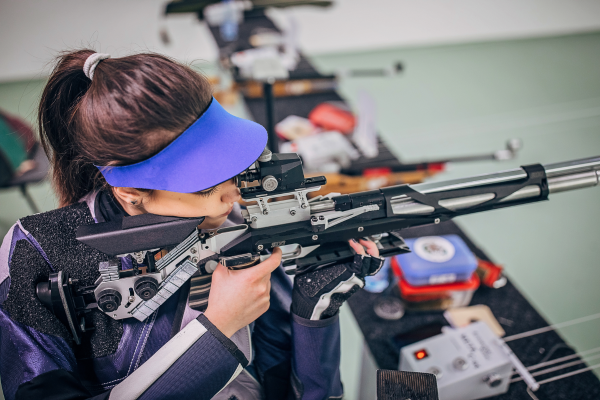
In shooting, true performance doesn’t come from the body or technique alone — it emerges from the harmonious integration of mind, body, and skill.
This unity can be likened to “yog in action” — where mental focus, physical precision, and technical mastery come together as one seamless experience.
When a shooter steps onto the range, every muscle, every breath, every thought works in concert.
The body echoes the mind’s intent; the mind directs the body’s execution.
Without this integration, even the most meticulously refined technique can fail under pressure.
Elite shooters across the world underscore this truth.
Olympic shooters emphasize that focus and calmness allow the body to execute what the mind has already rehearsed.
As some of the greatest marksmen have shared:
- “When you’re in the moment, your mind and body work together to create a perfect shot.” — Kim Rhode, multiple Olympic medalist.
- “You must control your mind before you can control your shot.” — Sergei Martynov, Olympic champion.
These words reflect the essence of mental training in shooting: it’s not just about thinking — it’s about bringing the mind into alignment with physical skill so that performance feels effortless and natural.
This “union” also mirrors the philosophy of classical yoga — where dhyana (focused attention) and asana (physical posture) unify the athlete’s internal and external states. Just as a yogi trains breath, posture, and presence, shooters develop routines that balance mental clarity, body stability, and technical consistency. The goal is to make performance automatic even under intense competitive stress.
Mental training becomes the bridge between physical preparation and peak performance.
Whether it’s visualization, steady breathing, or focus exercises, each technique strengthens the connection between mind and body — turning precision sport into precision art.
This deep integration doesn’t just improve performance; it fosters resilience, self-awareness, and consistency.
When the mind, body, and technique are aligned — every shot becomes an expression of inner preparation meeting outer execution.
In shooting, as in yoga, true mastery begins when mental and physical readiness merge into single, purposeful action — transforming skill into performance.
Conclusion: Train the Mind to Master the Shot
Shooting is more than a test of physical skill and technical precision. It is a precision sport where the mind plays a decisive role in every performance.
When the margin of error is small, mental clarity, emotional control, and focus become just as important as grip, stance, and trigger control.
True excellence in shooting comes from the union of mind, body, and skill. While physical and technical training shape the shooter’s form, mental training shapes the shooter’s consistency, confidence, and composure under pressure.
When athletes understand and train their mind deeply, they gain better control over their performance — not just in practice, but when it matters most.
If you’re a shooter looking to strengthen the mental game of shooting, now is the time to take that next step with MyMentalCoach.
📞 Call or WhatsApp +91 98237 91323
for a FREE 15-minute consulting call and learn how structured mental training can help improve focus, accuracy, and competitive performance.
Train the mind.
Align the body.
Master the shot.